A nervous system that doesn't spike.
Feel less wired and reactive — without adding one more thing to your to-do list. What winds you up is specific to your body, so your way back to calm should be too. Find your dosha free in 3 minutes and Vaidya builds it.

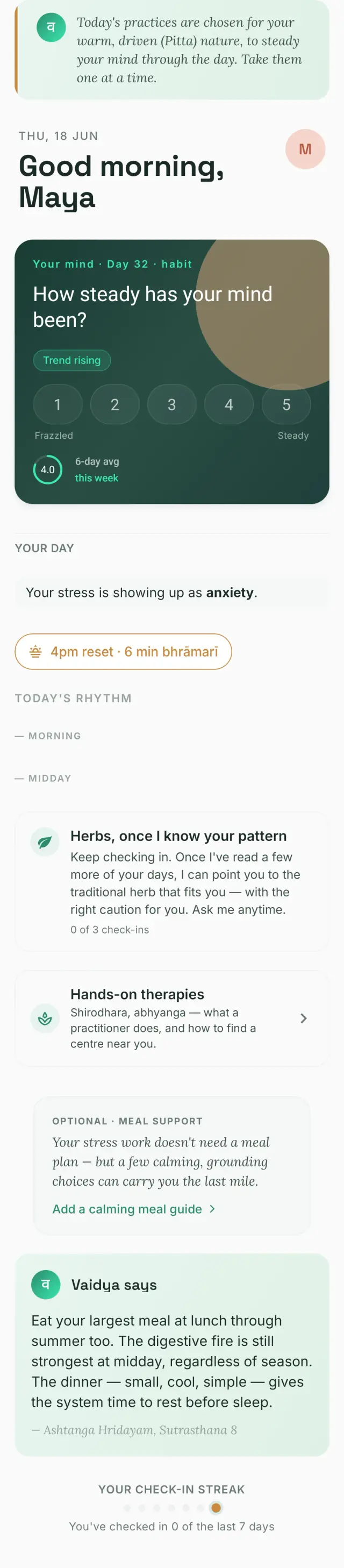

How does Ayurveda help with stress and anxiety? It matches calming habits — breathing, food and daily rhythm — to your dosha instead of one-size-fits-all advice. InnerVeda finds your type in a 3-minute quiz, then Vaidya builds a 90-day plan to steady your nervous system.
Stress keeps time — yours peaks at a predictable hour. Vaidya front-loads the antidote: the humming breath (bhramari) that replaces the second coffee.
Before the second coffee — six minutes of humming breath (bhramari). You'll thank me at 7pm.
Start the 6-min session →How do I recover from burnout?
Burnout, in Ayurveda, is usually Pitta over-drive that has run too long — perfectionism and heat depleting into a tired-but-wired Vata exhaustion. Recovery cools the load before it rebuilds: lighter, cooler food, a firm stop to the evening, scheduled rest instead of another push, and breath that settles rather than stimulates. The 90-day Stress arc paces this to your pattern.
The plan, in plain words.
Tailored to your dosha and season. The order matters.
Cool the bodyDAYS 1 – 14
Cooling food at every meal: cucumber, coriander, fennel, coconut. Cut coffee after noon — non-negotiable for Pitta, helpful for Vata too. Replace afternoon coffee with humming breath (bhramari) or fennel-coriander tea. Lower the ambient pressure before adding any new practice.
Breath ratioDAYS 8 ONWARDS
Alternate-nostril breathing (nadi shodhana), 8 minutes at dusk. The single most reliable Pitta cooler in the canon. For Vata the practice is slowed further (longer exhale than inhale). For Kapha it's replaced with energising breath (kapalabhati) in the morning instead.
The 4pm resetDAYS 14 ONWARDS
6 minutes of humming breath (bhramari) before opening Slack again. Humming-breath practices are associated with a shift in vagal tone and HRV within the same session — a small, concrete reset you can keep well beyond the arc.
Earlier supperDAYS 21 ONWARDS
Pitta runs on midday digestion (agni) — light dinners before 7:30pm are non-negotiable. Vata needs a heavier, warmer supper than Pitta. Kapha needs the lightest of the three, and sometimes skips supper entirely. Vaidya picks the right shape.
Three stressors, three patterns.
Each dosha breaks under stress in a different way, for a different reason. Find your pattern, fix the right cause.
The high-strung pattern. Worry, racing thoughts and a body that won't settle. The arc grounds it with warm ginger tea, morning oil massage, a screens-off wind-down and steady rhythm.
The irritable pattern. Tension that turns into a quick temper and a clenched jaw. The arc cools it with humming breath (bhramari) in the late afternoon, lighter cooling food, and a real pause before reacting.
The numb-it-out pattern. Stress that hides as comfort eating and screen-scrolling. The arc moves it instead — a brisk morning walk before breakfast and lighter, energising food.
What changes —
physically and mentally.
What the 90-day Stress arc is built to shift — across two axes.
- A calmer baseline — breathwork traditionally used to steady heart rate and the stress response.
- A steadier daily rhythm — a sharper morning, a less spiky afternoon.
- Less held tension in the jaw and shoulders as the nervous system settles.
- A longer gap between trigger and reaction — the space Pitta most needs.
- Less Sunday-night dread as the week stops feeling like a build-up.
- The shift towards “I notice before I escalate.”
The Ayurvedic view of stress
In Ayurveda, stress is not one experience — it expresses through whichever dosha is already dominant. Vata bodies break into anxiety, scatter, and insomnia. Pitta bodies break into anger, perfectionism, and heat. Kapha bodies break into withdrawal, comfort-eating, and lethargy. The protocol differs for each. The InnerVeda 90-day Stress arc personalises food, breath, daily rhythm, and herbal support to your specific pattern.
The mechanism Ayurveda watches is digestion (agni, अग्नि) and the energy reserve (ojas, ओजस) it builds: a steady digestive fire keeps the reserve that buffers the nervous system topped up, so a body under chronic stress stops over-spending it. The two pillars of the protocol — alternate-nostril breathing (nadi shodhana) to balance the channels (nadi) and the morning energising breath (kapalabhati) to lift a Kapha slump — are matched to your pattern rather than prescribed flat.
The scale of the problem
Sources: World Health Organization (WHO) on stress-related primary-care visits; peer-reviewed vagal-tone and heart-rate-variability (HRV) studies, 2018–2024, on bhrāmarī (humming-breath) practice.
Why not box breathing, Wim Hof, or the Apple Watch Breathe reminder?
They're tactical resets — 90 seconds when the nervous system has already spiked. Useful, but they patch the moment.
Ayurveda starts further upstream: whyyour particular dosha spikes in the first place. For Vata, it's irregular meals, screen-time after dark, too much input. For Pitta, it's coffee after noon, late dinner, deadlines without end. For Kapha, it's under-stimulation and heavy food.
Vaidya threads tactical practices (alternate-nostril, bhrāmarī, slow exhales) on top of the structural rebuild — the spike doesn't happen, and the tactic isn't the whole answer. This is also why a single calming herb is not the lever: ashwagandha steadies a depleted Vata, but a Pitta running hot needs cooling food and dusk breath, and a stuck Kapha needs morning movement — the herb only lands once the pattern is named.
The three stress patterns in detail
“I can't sit still, can't sleep, can't finish a thought. Hands cold, heart racing for no reason.”
- Worstearly morning + late evening (Vata hours)
- Feels likeracing thoughts, insomnia, light-headedness, restless legs, cold hands, worry that loops
- The causeirregular schedule, too much input, skipped meals, stimulants, screens late, multi-tasking
- The fixwarm cooked food only, oil massage at 7am, slow long exhales, screens off by 9, single-tasking, ginger tea, ashwagandha
“I'm furious that I'm 4 minutes behind schedule. I work through lunch and snap at my partner at 7pm.”
- Worstlate afternoon to evening (Pitta hours)
- Feels likeirritation escalating in ~7 sec, perfectionism, hot face, jaw clenched, headaches, self-criticism
- The causeover-control, deadlines, late dinners, coffee after noon, spicy/fried food, alcohol, unrelenting ambition
- The fixcooling food (cucumber, coriander, fennel, coconut), 4pm bhrāmarī instead of coffee #2, alternate-nostril breath at dusk, lights down by 9:30, surrender practice
“I don't really feel stressed — I just can't get going. I eat to soothe. The couch wins.”
- Worstmornings + post-meal afternoon (Kapha hours)
- Feels likelethargy disguised as ‘I'm fine’, emotional eating, low motivation, isolation, weight that creeps
- The causeunder-stimulation, sedentary life, heavy/sweet food, isolation, monsoon/winter, oversleeping
- The fixvigorous morning movement (intensity, not gentle yoga), kapālabhātī in the morning, bitter and pungent food, social connection, no afternoon naps, novelty
Stress expresses through whichever dosha is dominant. Vata breaks into anxiety and scatter, Pitta into anger and heat, Kapha into withdrawal and comfort-eating. The protocol differs for each.
Box breathing and Wim Hof are tactical resets — useful in the moment. Ayurveda rebuilds the underlying reason a specific body breaks under stress: irregular schedule for Vata, late dinners and over-control for Pitta, sedentary life and heavy food for Kapha. The 90-day Stress arc layers the right tactical practice on top of the right structural rebuild.
Pitta-pattern stress expresses as irritation within roughly 7 seconds of a trigger. The cause is usually late dinners, coffee after noon, unfinished work, and summer heat. The fix is cooling food, alternate-nostril breath at dusk, and a hard rule against caffeine after noon.
No. For diagnosed anxiety disorder, panic disorder, PTSD, or depression, see a clinical professional. Vaidya is a lifestyle companion that can complement clinical care by helping rebuild sleep, food, and rhythm — the foundations that make other support easier to sustain.
Bhramari (बह्रामरी, ‘bee breath’) is a humming exhalation that vibrates the vagus nerve and palate. Six minutes activates the parasympathetic nervous system measurably — heart rate variability rises, cortisol drops. It's the fastest non-tactical Pitta cooler in the canon.
Yes, with adaptations. Both are predominantly Vata + Pitta phases requiring grounding food, oil massage, longer rest, and very gentle breath (no fast or heating practices). Tell Vaidya which phase you're in and the arc adapts.
Likely Kapha-pattern stress — the most under-recognised of the three. Lethargy, comfort-eating, low motivation, and emotional withdrawal are how stress shows up when Kapha is dominant. The fix is movement, lighter food, social connection, and kapālabhātī breath — not more rest.
Three minutes from here to a real plan.
The quiz finds your stress pattern. Vaidya writes the 90-day arc.
Ayurvedic Medical Officer · BAMS · for classical accuracy & safety