Ghee: Benefits & Dosha Effects
Sanskrit: Ghrita (घृत)
Ghee is especially balancing for Vata and Pitta but can raise Kapha when eaten in excess. With sweet rasa (taste), cold virya (potency) and sweet vipaka, it is heavy, oily and smooth in quality and a source of butyric acid.

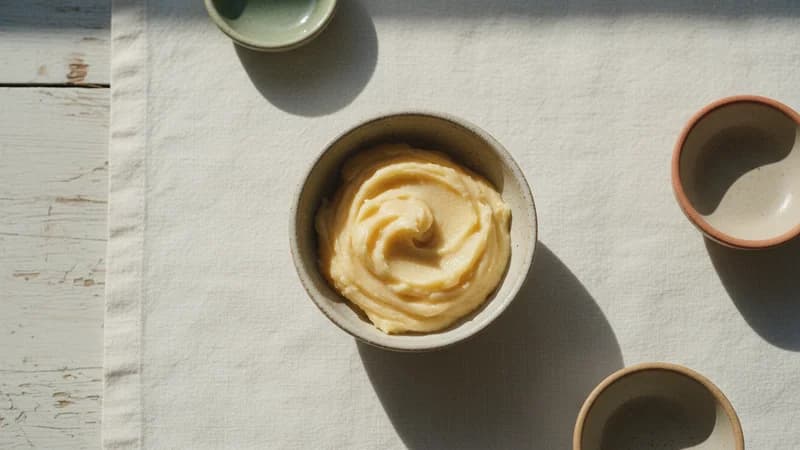
Ghee is best suited to Vata and Pitta, which it helps pacify. In excess it can raise Kapha. Declared Agrya (foremost) among all fats and oils by the Charaka Samhita, and the classical medium for Rasayana (rejuvenative) preparations.. Suitable year-round.
Ayurvedic Profile
Ghee, known as Ghrita in Sanskrit, occupies the highest position among all fats and oils in Ayurvedic medicine. The Charaka Samhita declares Ghrita as Agrya (best) among Sneha Dravyas (oleating substances) and describes it as the ideal medium for all Rasayana (rejuvenative) preparations. The Ashtanga Hridaya elevates it further, stating that ghee is Pittanilaharam (Pitta and Vata pacifying), Rasayanam (rejuvenative), Chakshushyam (vision-promoting), and Agnivardhakam (digestive fire-enhancing) simultaneously.
Ghrita possesses Madhura (sweet) rasa, Sheeta (cold) virya, and Madhura (sweet) vipaka with Guru (heavy), Snigdha (oily), and Mridu (soft) gunas. This profile makes it the supreme Snehana (oleation) substance, capable of penetrating all seven Dhatus and nourishing them from the deepest level. The Charaka Samhita explains that ghee's capacity to carry the properties of other substances (Yogavahi) without losing its own qualities makes it the ideal Anupana (vehicle) for herbal medicines.
The distinction between fresh ghee and aged ghee (Purana Ghrita) is a hallmark of Ayurvedic sophistication. The Sushruta Samhita describes Purana Ghrita aged for 10 or more years as possessing dramatically enhanced therapeutic potency, particularly for neurological conditions, epilepsy, and deep-tissue toxicity. The aging process transforms its qualities, making it lighter and more penetrating while maintaining its nourishing essence.
Ghee's role in Panchakarma is fundamental and irreplaceable. The preparatory phase of Panchakarma, Snehana (internal oleation), typically uses medicated ghee (Sneha Pana) to saturate the tissues and loosen embedded Ama before the purificatory procedures. Without proper Snehana with ghee, the deeper cleansing actions of Virechana and Basti cannot effectively reach and remove toxins from the Dhatus.
From a modern nutritional perspective, ghee's butyric acid content supports intestinal mucosal health and has demonstrated anti-inflammatory properties in the gut. Its high smoke point (approximately 250C) makes it the safest cooking fat from the perspective of avoiding harmful oxidation products. The absence of milk solids means it is often tolerated by those with lactose intolerance, making it accessible to a wider population.
Ayurvedic Properties
Rasa (Taste)
sweet
Virya (Potency)
cold
Vipaka (Post-digestive)
sweet
Guna (Qualities)
heavy, oily, smooth
How Ghee Affects Vata, Pitta & Kapha
Ayurveda reads every food through the three doshas. Here is how ghee’s qualities interact with each: Not sure which is yours? Take the free dosha quiz — about 4 minutes.
Ghee helps pacify Vata. Its cold virya (potency) and heavy, oily and smooth qualities, with its sweet rasa (taste), counterbalance Vata's tendencies — which is why it traditionally suits Vata dosha in regular use. Vata meal plan
Ghee helps pacify Pitta. Its cold virya (potency) and heavy, oily and smooth qualities, with its sweet rasa (taste), counterbalance Pitta's tendencies — which is why it traditionally suits Pitta dosha in regular use. Pitta meal plan
Ghee is well tolerated by those with Kapha dosha in normal amounts, but its cold virya and heavy, oily and smooth qualities may aggravate Kapha in excess — so people with Kapha as their leading dosha are best keeping to measured portions. Kapha meal plan
Nutrition Facts (per 100g)
900kcal
Calories
0g
Protein
0g
Carbs
100g
Fat
0g
Fibre
Ayurvedic Benefits
- Declared Agrya (foremost) among all fats and oils by the Charaka Samhita, and the classical medium for Rasayana (rejuvenative) preparations.
- Classically praised as unique in kindling Agni without aggravating Pitta, thanks to its sweet rasa and cooling (sheeta) virya — so it nourishes without stoking heat, a quality milk and seed oils do not share.
- Yogavahi (carrier) quality: it ferries the properties of herbs and the fat-soluble vitamins A and E inward toward the seven dhatus, traditionally used to support absorption.
- Its butyric acid is a preferred fuel of the colon lining, and ghee is traditionally used to support a settled, well-lubricated gut and healthy Grahani (digestive function).
- As Snehana (oleation), it lubricates the joints, softens the stool and nourishes Majja dhatu, so Vata dryness and stiffness may be eased.
How to Use
- As ghee is cooling (shita virya), favour it in warmer weather and pair it with warming spices like ginger or black pepper when the seasons turn cold.
- Stir one teaspoon of warm ghee into cooked rice, dal or khichdi at each meal to carry spices and aid assimilation.
- Cook and temper with it as your everyday fat — its high smoke point (around 250C) means it stays stable where many seed oils oxidise.
- Use it as the Anupana (vehicle) for herbal powders such as Brahmi or Shatavari, letting the ghee carry them inward.
- For Nasya (nasal oleation), use only a purpose-made nasya ghee and follow a qualified practitioner's guidance rather than self-dosing, as technique and suitability matter.
- Bloom whole spices — cumin, hing, curry leaf — in hot ghee to make a tadka, releasing their fat-soluble aromatics.
Contraindications
- Kapha-increasing in excess; Kapha types and those managing Meda dhatu (body-fat) or raised cholesterol should keep to 1-2 tsp daily and check with their physician.
- Best limited when Agni is low and Ama (undigested residue) is heavy — its heavy, oily guna sits poorly until the channels are clear.
- At around 900 kcal per 100g it is calorie-dense; measure by the teaspoon rather than pouring, and count it within the day's fat.
“Ayurveda classifies Ghee by its sweet rasa (taste), cold virya (thermal potency), and sweet vipaka (post-digestive effect). InnerVeda reads these three lenses together to map Ghee to your dosha and season.”
Frequently Asked Questions
Usually, yes. Clarifying butter into ghee simmers off the milk solids, so the lactose and casein that trouble sensitive people are reduced to trace amounts. This is what sets ghee apart from milk, which retains its lactose. Start with a small amount to confirm your own tolerance, especially if your sensitivity is severe.
Ghee is butter with the water and milk solids cooked away, leaving pure golden butterfat. That gives it a much higher smoke point (around 250C versus butter's roughly 150C), so it resists burning at frying and tempering heat, and it keeps well at room temperature.
For most constitutions, 2-4 teaspoons spread across meals is a comfortable amount. Vata types may take a little more; Kapha types are better nearer 1-2 teaspoons. Because it is pure fat at around 900 kcal per 100g, measure by the spoon rather than the ladle.
Your dosha is the balance of Vata, Pitta and Kapha you were born with. Take the dosha quiz — free, about 4 minutes.
Three questions towards your dosha
These are the first three questions of the full dosha quiz. Answer them here and carry on where you left off.
Prefer to start from the beginning? Take the full dosha quiz.
Dietary information provided is for educational purposes only and is rooted in Ayurvedic tradition. It is not a substitute for professional nutritional or medical advice. Consult a qualified healthcare provider before making significant changes to your diet, especially if you have food allergies, intolerances, or a medical condition.
Want a meal plan matched to your dosha?
Take the free dosha assessment (about 4 minutes) and get a personalised nutrition plan with nearly 300 foods in the app, rated for your body.
Find Your Dosha: FreeAbout 4 minutes